Rising monster wave star talks about hot surf spots, his training regimen and growing up surfing the shores of La Jolla.
Derek Dunfee is sitting on the bluff overlooking his local spot of Windansea in La Jolla.
There is a two-foot south swell lumping up on the reef, burgeoning its way into the channels on either side of the peak. A pack of frothing grommets devours the ones that don’t cap out the back and unload on virtually dry sand.
Derek turns and jogs to the car; he’s probably going home, maybe doing some training with his brother or some yoga. Perhaps he’s off to pick up a new wetsuit from his sponsor at Matuse.
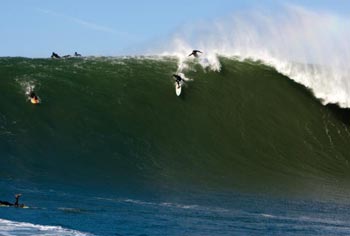
Instead, Derek suits up, pulls a sweet little twin fin Stu Kenson fish from the back. The waves are a far cry from the $15,000 behemoth he dropped into last winter as the Monster Paddle champion at Mavericks but Derek is obviously amped. Why? Derek loves surfing. And it is that love that is quickly making him one of the most recognized big wave surfers in San Diego surfing history.
I recently got a chance to rap out with Dunf’ and learn a bit about what it takes to be a big wave rider on a stretch of coast that rarely delivers anything more than “fun” sized waves.
SDNN question: San Diego isn’t the first place that comes to mind for breeding big wave surfers. What local spots played a role in getting you into XL surf?
Dunfee answer: I grew up surfing a variety of waves in La Jolla. The reefs in La Jolla and Blacks Beach played a big role in pushing my comfort level in big waves.
Q: How hard is to adjust to big waves at say Mavericks or Puerto Escondido after enduring a So Cal flat spell?
A: It isn’t that hard to adjust because I plan my trips around the seasons. There are no long flat spells for me, I try to keep moving. Places like mainland Mexico and the South Pacific are good during the summer, and big wave spots in California are good in the winter. There is always big swell somewhere in the world, so I try to constantly stay in good shape, so I am always ready.
Q: What do you do to train for those frigid hold downs?
A: I surf once or twice a day, do Bikram yoga a few times a week and I swim in a pool. My brother is a personal trainer at Sharpe fitness in La Jolla, so I do cross-fit type workouts twice a week with him as well
Q: Where do afternoon surfs at Windansea fall now that you’ve caught a $15,000 Mavs monster? How do you stay motivated to surf normal day-to-day and often times sub-par conditions at home?
A: It’s real easy for me to stay motivated to surf normal day-to-day conditions in San Diego because I love to surf. The only way to stay in shape for surfing and to stay in tune is to surf everyday. A motivating factor when I am training for big waves is if I am surfing everyday and feel in tune. Plus, I am lucky because my shaper Stu Kenson shapes me a lot of really different small boards to keep it fun.
Q: What local big wave guys have you looked up to?
A: There is a group of guys from San Diego who always motivate me to keep pushing it. Greg Long and Nathan Fletcher are from San Clemente, and they are some of the best big wave guys in the world at the moment. Garth Englehorn is a local guy who charges really hard at Todos Santos (Baja Mexico). My good friend Johnny Maher from La Jolla has been charging everywhere from Puerto, to Chile to Hawaii this year.
Q: Who got you into big surf?
A: I always liked to challenge myself and push my surfing, so it was a slow and steady rise up the big wave totem pole. One person who helped me a lot was the Mavericks big wave charger Zach Wormhoudt. Zach was part of the first group of guys charging Mavericks in the early ’90s. Five years ago, I met Zach and he was really nice. He taught me so much about big wave surfing and equipment. He took me out to Mavericks my first time.
Q: Has Todos Santos played a role in your big wave upbringing?
A: I have surfed Todos a handful of epic times, but I haven’t put as much time as I should. I didn’t surf out there ’til I was 20, and I missed a few of the historic days like the day Brad Gerlach won the biggest wave. The past two years, Baja Mexico has gotten a lot more scary to travel to, so that makes me a little hesitant to go down there unless the swell and weather are perfect.
Q: Do you have tow-in aspirations? Cortez Bank? Jaws? Shipsterns?
A: Yeah I do like to tow-in, but the last few years I have focused on paddling in. I would love to tow Shipsterns, but Jaws looks really scary.
Q: How nervous are you paddling out at big Mavs? What goes through your head when you spin, paddle and commit?
A: I am more nervous on the drive to Mavericks then paddling out. My nerves usually calm once I get in the water; it’s all the anticipation that kills me. Usually, if I am paddling for a wave I feel pretty confident. I go through times in the lineup when I feel confident or scared, so if I feel scared I will sit on the shoulder to gather my nerves. If I feel confident and want the wave, I am 100-percent committed that I am gonna make the wave. It’s the only way to think about it because if you hesitate, it’s too late.
Q: What’s your plan for next winter? Travels?
A: I am going to stay in California and try to surf every Northwest swell that hits Hawaii and California. I put some money away from my XXL win just for next winter.
Although it is summer on this side of the world don’t expect any slowdown to Derek’s big wave antics. You can follow up on his global big wave strikes in the news section of the Matuse Web site.