Note: this report seems to have several flaws.
1. 79% of data comes from a form, the rest from news ect. The site itself notes this problem, “accounts of what happened were based primarily upon information supplied by persons who were neither the objects of the attacks nor were they even there at the time to actually see what happened”
2. Also this report seems to be cherry picking the data to some degree. Note that shark attacks this year for surfers was up, but if you look at the bigger picture divers made up the majority of attacks: divers 50 (46%) ; surfers, 41 (38%); swimmers, 12 (11%); and kayakers, 5 (5%).
3. The Committee is focused on the Pacific Coast of North America.
4. Lastly, this site is providing a valuable service to the International Shark Attack File, so I thank them for their work.
To get a broader view of shark attacks world wide visit the ISAF.
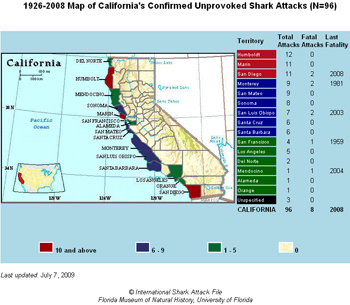
There were 7 unprovoked shark attacks authenticated from the Pacific Coast of North America during 2009. All 7 of the reported attacks occurred in California and were distributed in the following months; April (1), July (1), August (2), October (1) and November (2), with 5 of the 7 attacks occurring South of the Santa Barbara/Ventura County line.
Activities of the victims were; 3 Surfing, 1 Paddle-Boarding, 1 Diving, 1Surf- Fishing, and 1 Swimming. The Great White Shark, Carcharodon carcharias, was positively identified or highly suspect as the causal species in 5 of the attacks with 1 attack attributable to the Thresher Shark, Alopias sp., and 1 unknown species.
The publication “Shark Attacks of the Twentieth Century” authenticated 108 unprovoked shark attacks from the Pacific Coast between 1900 and 1999. The Great White Shark was implicated in 94 (87%) of the attacks with an annual average of slightly more than one shark attack per year. The 7 cases reported for 2009 brings the total number of unprovoked shark attacks occurring along the West Coast during the first 9 years of the 21st Century to 49.
This is ‘more than five times’ the Twentieth Century annual average and represents 45% of the total number of attacks reported for the entire Twentieth Century, and all in less than a decade. The Great White Shark has been implicated in 41 (80%) of the 49 attacks reported during this Century. Of the 157 unprovoked shark attacks reported from the Pacific Coast since 1900, the Great White Shark has been positively identified or highly suspect in 133 (85%).
Victim activity for the 49 unprovoked shark attacks reported from the Pacific Coast since 20000 are distributed in the following groups; surfers 35 (71%) of the documented attacks with 5 (10%) swimmers, 3 (6%) kayakers, 3 (6%) divers, 2 (4%) paddle boarders, and 1 (2%) surf fishing. The number of adult, sub-adult, and juvenile Great White Sharks observed in Southern California during 2009 suggests a possible change in their population dynamics and seasonal site preferences.
The number of stranded marine mammal carcasses reported, specifically their location and time of year, would seem to support this observation. The Shark Research Committee will continue to closely monitor this activity in the coming year.
Additional information regarding the Shark Research Committee’s conservation, education, and research programs are available at: sharkresearchcommittee.com. ‘Save the Sharks – Save the Oceans’
www.sharkresearchcommittee.com
International Shark Attack File