Category Shark

SUP Shark Encounter at
San Onofre
0

Jul13

San Onofre State Beach — On July 11, 2009 Brian Hovnanian and companion Lance E. were Stand Up Paddleboarding at the reef South of Dog Patch, San Onofre State Beach. It was 8:30 AM and they had been on the water 1.5 hours. It was sunny with little or no wind and an air temperature in the low-70s Fahrenheit. The ocean was calm and glassy with water visibility 4 – 5 feet and a temperature in the upper-60s Fahrenheit. They were about 50 yards from shore over water about 6 feet deep with a sandy, rocky bottom. No marine mammals were observed in the area. Hovnanian reported: “I was paddle surfing at the reef South of Dog Patch, with one other paddle surfer, Lance E. I have had many shark sittings of 5′ to 6′ sharks jumping all of the way out of the water at this same place for the last 2 months, as I paddle surf their a couple times a week. I had not seen any today and did not see this one coming. We both had just ridden waves in from a nice set. As I was paddling out, my friend was paddling about 30 feet behind me when all of a sudden it felt like something hit the back of my SUP, then slammed into the back of my left calf, forcing me to lose my balance and I feel backwards. The shark was now on top of my SUP and I was lying backwards on top of the shark, as it was on my board. The shark slithered off the board back into the water. This all happened so fast, and I believe when I fell on the shark, it scared it and it tried to get away from the board and me. I still had my paddle in my hand, jumped to my feet on my board and looked at my leg, to notice nothing had happened to my body or board. By now my friend had paddled quickly to me and could not believe what he had just seen right in front of him. He made sure I was OK, luckily I was, then we paddled back out to the line-up and caught a wave from the next set and paddled in thinking how lucky I was. I’m not sure what kind of shark it was, but it did have a gray back and white underside and was about 5 feet in length. It might have been a Mako or White Shark.” By definition an unprovoked shark attack is “any physical contact between a shark and human, or piece of equipment being utilized by a human, without any know provocative action by the subject which might cause the shark to strike out.” This is the second authenticated unprovoked shark attack for 2009 from the Pacific Coast of North America. Please report any shark sighting, encounter, or attack to the Shark Research Committee.
story via surfline

Surfer survives shark attack by
grabbing tail to stop it biting him
0

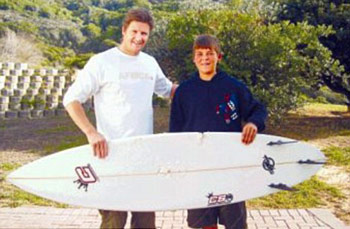
A surfer has spoken of the moment he was forced to hang on to a shark’s tail in a desperate battle to survive.

Paul Buckley grabbed hold of the creature in a bid to restrain it after it sunk its teeth deep into his leg.

‘I  was actually paddling back to shore because I hadn’t had that great surfing when I was flipped in the air with such force,’ he said.

I just knew in my  gut that it was a shark. It  was like a 500lb Rottweiler in a very bad mood.

‘The force was incredible. The first thing I said when I was attacked  was “No, please God not like this.”

‘I didn’t see the shark’s eyes because his back was towards me but that was when  I grabbed its tail.

‘No doubt I was scared. I feared for my life so I just grabbed it. I thought if I held it by the tail, its mouth could not reach me again.’

Mr Buckley, 37, was released after a few seconds and then frantically swam the 100m back to shore near Stilbaai, which is near the tourist resort of MosselBayon which faces the Indian Ocean.

Witnesses bundled him into a car and rushed him to a doctor so the bite – which was nearly 37cm wide and 3cm – could be closed.

The businessman was then taken to hospital where he received 150 stitches.

‘If  it had been a little further over to the left or right, or if it had taken out a chunk, it could have been much worse,’ he said.

It’s  one of those things that just happens. If you look at the probability,  it’s just so unlikely.

‘The shark was doing what comes naturally – looking for food.

‘I owe him one really  because he could have easily come back and clamped his teeth round me but he didn’t and just swam away.

‘But yes, I’ll certainly still surf.’

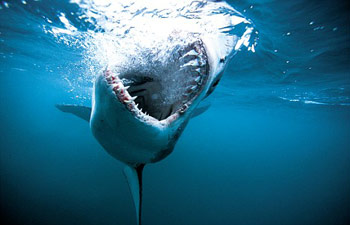
LIfeboat spokesman Rico Menezies estimated the shark was three-and-a-half metres  long. ‘I’m certain it was a great white,’ he added.

Despite the number of sharks that swim off the warm seas  of South  Africa, attacks are still quite rare with an average of six a year.

Since 1990, only a quarter have resulted in serious injury and only 12 per cent have been fatal.

Scientists believe surfers are at increased risk because sharks mistake them for seals, which are easy prey.

Great Whites, which can grow up to 6m, are especially prevalent off  False Bay, Cape  Town, which has one of the highest densities of the  killer fish in the world.

original story dailymail.co.uk

Sharks face extinction due to Chinese demand for fins 0

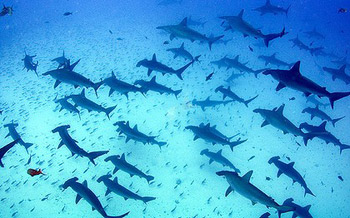
A third of the world’s open-water sharks — including the great white and hammerhead — face extinction, according to a conservation survey that singles out overfishing as the main culprit. The survey of 64 species of open-water sharks and rays by the International Union for the Conservation of Nature notes the demand for shark fins, considered a Chinese delicacy, has soared along with income levels in China in the past decade.

Flinders University shark ecologist Charlie Huveneers says the proportion of sharks endangered was higher for the open-water sharks than for sharks in general, mainly because they were large species with slow reproductive rates and were slow to mature. Some, such as the grey nurse, produced only two pups every two years.

“That’s one of the reasons why that species is listed as critically endangered in NSW,” he said. Open-water shark species also lived in areas that were heavily fished and hard to regulate. The report identified the great hammerhead and scalloped hammerhead sharkand the giant devil rays as endangered. The smooth hammerhead, great white, basking and oceanic white-tip sharks are listed as vulnerable as are two species of makos.

Dr Huveneers said fishermen targeted sharks for their fins. The rest of it was discarded. Shark meat can fetch $1-$5 a kilogram, but the fin could bring up to $200 a kilogram. Commercial swordfish and tuna fisherman also caught sharks such as the blue shark and mako shark accidentally. Sharks are important in the ecosystem, especially those at the top of the food chain such as the white, great white and great hammerhead.

Reducing their numbers could prompt an increase in the number of cownose rays, which consumed scallops. “The cascading effect of the decreasing of large sharks has an impact on the whole ecosystem, including humans who work in and benefit from the scallop industry,” he said.

original story from theage.com.au