Category Nature

Ocean Friendly Gardens Invade Amazon.com 0
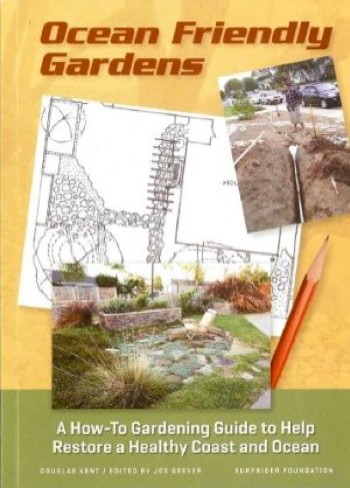
There is a new buzz in the landscaping world — residential gardens that incorporate beautiful plants that thrive in our local climate and limit the necessity for irrigation and maintenance. The Surfrider Foundation and landscaping expert Douglas Kent have taken this concept a step further to include simple design ideas that will dramatically reduce runoff from properties that pollute creeks and beaches in a new manual available now for novice and expert gardeners: Ocean Friendly Gardens: A How-To Gardening Guide to Help Restore a Healthy Coast and Ocean.

Taking cues from the Surfrider Foundation’s “Ocean Friendly Gardens” program, the book describes how green-thumbs can help restore our precious oceans by applying simple practices to their gardening and landscaping routines including CPR – conserving the use of water, fertilizers and pesticides, increasing permeability so the landscape or garden holds more water, and developing water retention areas.

“With a growing trend of creating beautiful gardens that used native plants and other ‘climate-adapted’ vegetation, we wanted to show people how they could also help reduce water pollution,” said Chad Nelsen, Surfrider Foundation’s Environmental Director. “The result is a fantastic program

The Surfrider Foundation’s “Ocean Friendly Gardens” program developed from members’ personal contributions to their gardens and landscapes in an effort to restore and protect our oceans, waves and beaches. The results were unique and beautiful residential gardens that attracted the admiration and curiosity of the community.

Ocean Friendly Gardens: A How-To Gardening Guide to Help Restore a Healthy Coast and Ocean is available now at Amazon.com

Study warns of health risk in
playing with beach sand
0

Add playing in the sand to the long list of fun things that may be bad for your health.

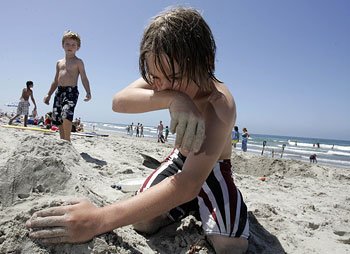
A new study says you risk getting an upset stomach and diarrhea if you dig into the granular stuff to fill toy pails, build sand castles or bury yourself. You’re better off walking along the shore or swimming in the surf.

Is the federal government, which paid $63,500 for the research, throwing a major bummer into the beach-going season? San Diego County’s 76 miles of coastline are dotted with dozens of state and city-run beaches.

Or maybe yesterday’s publication of the information is a nefarious plot against the 29th annual U.S. Open Sandcastle Competition, which is expected to attract 300,000 people to Imperial Beach this weekend.

The report’s authors said they don’t mean to put a damper on summer fun. They just think it’s important to caution people about the bird droppings, urban runoff, sewage and other contaminants that pollute sand.

“Take care to use a hand sanitizer or wash hands after playing in the sand,” said Tim Wade, an epidemiologist with the U.S. Environmental Protection Agency who helped write the study.

Debbie Longley, chairwoman of the sand-castle contest, said she isn’t aware of participants being sickened by tainted sand during past competitions. The event is a bright spot for Imperial Beach, the long-suffering recipient of Tijuana River sewage overflows that have caused many shoreline closures.

“Going to any beach presents some element of health hazards, but I think (the study) will be the last thing on people’s minds when they are out . . . at the sand-castle competition,” Longley said.

As part of a larger assessment of water quality at beaches, EPA researchers interviewed more than 27,000 beach-goers in 2003, 2004, 2005 and 2007. There were four sites on the Great Lakes and one each in Mississippi, Alabama and Rhode Island.

read full story at signonsandiego

Surfing on Venus? It could have happened, scientists say. 0

Oceans once bathed Venus, and continents once shifted on its surface, suggests a spacecraft map released Tuesday. Today, Venus endures 800-degree temperatures and sulfuric acid rains. But a Venus Express spacecraft map of the planet’s surface released by European Space Agency scientists suggests granite covers its southern highlands, which means that the weather there was once balmier.

“If there is granite on Venus, there must have been an ocean and plate tectonics in the past,” says study chief Nils Müller of the University Münster and DLR Berlin, in a statement. In a Journal of Geophysical Research report, the study team suggests that heat signatures given off by the nighttime surface on southern Venus confirm the granite finding. Granite only forms on Earth when volcanic rocks are pulled beneath ocean floors by continental drift, and then return to the surface.

Such a process may have happened on Venus, before its atmosphere heated to its current temperatures. “This is not proof, but it is consistent. All we can really say at the moment is that the plateau rocks look different from elsewhere,” adds Müller. The team suggests future Venus landers aim for the granite regions to confirm the finding.

original story from usatoday