Sean Collins Paddleout 0
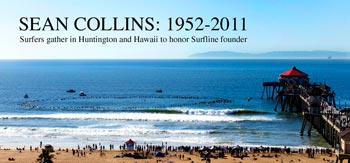
Follow the link to view photos of paddleout on Surfline
http://www.surfline.com/surf-news/sean-collins-paddleout_64687/
Follow the link to view photos of paddleout on Surfline
http://www.surfline.com/surf-news/sean-collins-paddleout_64687/
The words “Follow Your Passions” will forever be inscribed in concrete on the corner of Pacific Coast Highway and Main Street.
Sean Collins, the founder of Surfline.com, wrote the phrase when he was inducted into the Surfers Hall of Fame in 2008 and lived by those words. The influential surfer dedicated his life to following waves, tracking winds and sharing stories of swells with the world.
Collins, 59, died Monday from natural causes, according to the Orange County coroner’s office.
His youngest son, A.J., said Collins was playing tennis at his club in Newport at about 2 p.m. when he died suddenly from a heart attack. The family was together, trying to grapple with the news.
For the surfing community, Collins’ death means the loss of one of the most influential surfers in the world. He changed the way people sought out waves around the world.
Collins founded Huntington Beach-based Surfline, which started as a phone service and became one of the most powerful surf forecasting web sites in the world, guiding surfers who once aimlessly searched for waves but now had information readily available to predict the best windows for waves.
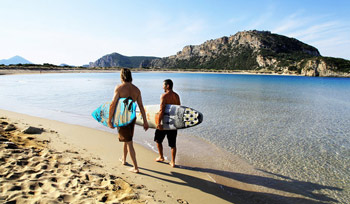
BOLTS of lightning flashed in cobweb patterns overhead, the gray and storming sea sending wave after wave that crashed on the beach behind us. We paddled our borrowed surfboards furiously southward to avoid the whitewash, then, one by one, turned into the arching faces and rode them to shore.
This wasn’t supposed to happen. There is no surf in Greece, fellow boarders had told me when I was planning my Greek surf safari. Yes, they said, Greece is surrounded by three seas and boasts nearly 10,000 miles of coastline and about 6,000 islands and islets that could be suitable for surfing. But this is the Mediterranean — too sheltered for wind and water to produce waves any bigger than a foot or two, none of which would be surfable.
And yet a quick Internet search suggested otherwise. About a half-dozen Greek Web sites advertised photographs of big, beautiful waves crashing on both the Ionian and Aegean coasts. Not storm-ripped slop but smooth, Hawaiian-style breaks with not a soul in sight.
In mid-September, during a trip to Greece, I decided it was time to see for myself. I selected a beach on the Ionian Coast at random from a tourist map, threw my swim trunks and some surf wax into my rental car, invited two new friends along, and headed west from Kalamata to the tiny port town of Pylos.