Archive May 2010

Billabong To Acquire Becker Surf and Sport 0
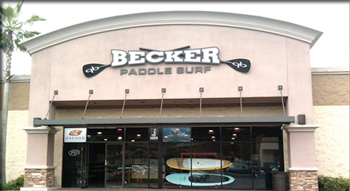
Billabong International Limited today announced it has reached agreement to acquire the Southern California surf retailer Becker Surf and Sport.  The acquisition includes Becker’s five brick and mortar retail stores and the beckersurf.com online business, but does not include the Becker Surfboards arm of the business.

Billabong North America president, Paul Naude, said Becker is an iconic surf retailer and holds a distinguished place in the surf industry. “Becker is a name that has been synonymous with surf since the 1970s and, as both a brand and a retailer, it has helped shape Californian surf culture,” said Mr Naude.

“Billabong looks forward to preserving the Becker heritage and growing the speciality boardsports retail channel to ensure premium brands can continue to deliver an authentic experience to the end consumer.” Dave Hollander, co-founder and president of Becker, said Billabong and Becker had a mutual respect for one another’s place in the industry and a shared vision about the future of surf retailing.

“Paul and I have been friends for years and we have always discussed the future of the industry and boardsports retailing and have a common goal to ensure specialty retail remains intact,” he said.  “We were looking for a strong partner to take the Becker brand to the next level and Billabong is a perfect fit.

“Billabong, through Paul, understood that we wanted to keep the surfboard name and manufacturing. They understood how important it was to keep that part of our heritage in the families that have owned it for 30 years. “That was a big deal for us and few others would have understood the dynamics of this in relation to the big Becker picture.”

Becker Surf and Sport and the online business will both continue to operate as multi-branded retailers. The acquisition price was not disclosed.
story via Transworld

Aritz Aranburu wins at
Maresia Surf Int’l 6 Star event
0

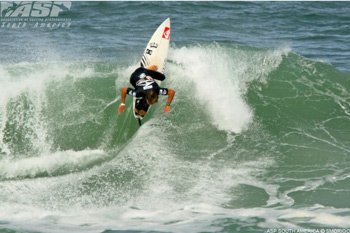
FLORIANOPOLIS, Santa Catarina/Brazil (Sunday, May 23, 2010) – On the decisive heat of the event, Aritz Aranburu took two regular waves to claim the title of Maresia Surf International 2010 in Florianopolis, Santa Catarina, Brazil. The Brazilian Rodrigo Dornelles was second place, finalized the 12.67 x 6.67 points in the good waves at Mole Beach in Sunday.

“I’m so happy. It was a very good event for me, we had some pretty hard days and today everything went right to me,” said Aritz Aranburu, who jumped from 60th to the 35th place on the newASP World Rankings. “Unfortunately, we could not get good waves in the final, I did not surf my best, but that was good enough to win. Rodrigo (Dornelles) is a great surfer and was a pleasure to make the final against him. It’s great to win here in Brazil.”

MARESIA SURF INTERNATIONAL RESULTS
FINAL:
1 –
Aritz Aranburu (EUK) 12.67
2 – Rodrigo Dornelles (BRA) 6.67

SEMIFINALS:
SF 1:
Rodrigo Dornelles (BRA) 13.17 def. Gabriel Medina (BRA) 10.94
SF 2: Aritz Aranburu (EUK) 12.40 def. Caio Ibelli (BRA) 11.17

QUARTERFINALS:
QF 1:
Rodrigo Dornelles (BRA) 8.77 def. Robson Santos (BRA) 10.94
QF 2: Gabriel Medina (BRA) 10.90 def. Sebastien Zietz (HAW) 10.33
QF 3: Caio Ibelli (BRA) 9.26 def. Pedro Henrique (BRA) 10.33
QF 4: Aritz Aranburu (EUK) 11.93 def. Leandro Bastos (BRA) 10.33

read original story/photo via asp

Shark Skin nano-coating could make surfboards faster? 0

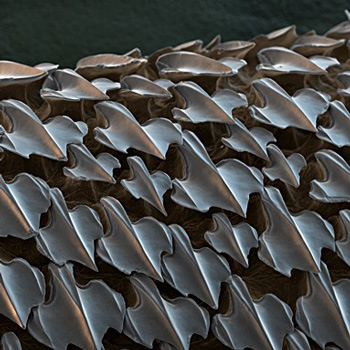
We’re gonna need a bigger wind turbine. Or maybe not. German researchers are using shark skin to make windmills spin more efficiently, and generate more electricity. Not real shark skin, thankfully. This is shark-line skin that can be painted onto wind turbines, airplanes and ships to reduce flow resistance, or drag. Does this make your “Jaws” drop?
This type of biomimicry has already been tried with cars, to improve mileage, as Michael reported last year. The latest version comes from Fraunhofer-Gesellschaft in Germany, dubbed as the leading organization for applied research in Europe.
Shark skin was the inspiration because fast-swimming sharks have evolutionary scales that allow them to move quickly through the water and nab their prey. Swimmers and surfers, take note.
The shark paint was developed by Yvonne Wilke, Volkmar Stenzel and Manfred Peschka of the Fraunhofer Institute.
They say the paint system can lower costs, and as a result, carbon dioxide emissions. The recipe for the aerodynamic skin involves nanoparticles, to allow the paint to withstand ultraviolet radiation, temperature change and mechanical loads, according to information from the institute.
The paint lasts for about five years, at which time it has to be removed and reapplied. The paint is applied with a stencil (according to Stenzel), to give it a shark-skin structure.
For wind turbines, and commercial wind-energy parks, the paint could reduce air resistance, improve efficiency and result in greater energy generation, the researchers say. They estimate the paint could save almost 4.5 million tons of fuel a year if applied to every airplane in the world. Now that would be quite a contract.
For a large container ship, the paint could reportedly reduce wall friction by more than 5 percent a year, saving 2,000 tons of fuel annually.
The next task for the Germans: To develop shark skin paint that resists algae or mussels that accumulate on ship hulls.

read more at treehugger.com