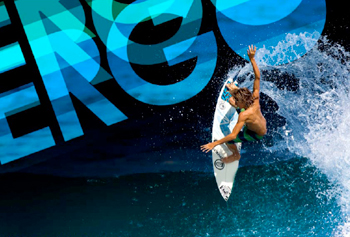
The 2009 Billabong XXL Global Big Wave Awards presented by Monster Energy is coming to the ESPN networks this week across the USA. Known as the Oscars of surfing, the ninth-annual XXL show is scheduled for the ESPN2 channel this Thursday, May 28, at 9:30 P.M. Pacific Time, 7:30 P.M Hawaiian (1:30 A.M. late-night on the East Coast). Check your local listings for the correct channel in your area and set your TIVO or DVR now.
For a preview of the show:
The hour-long special features the biggest waves and most spectacular rides from around the world over the last year. Highlights of the high-surf action include Californian Greg Long’s unprecedented paddle-in barrel at Dungeons in South Africa which earned him the $50,000 XXL Ride of the Year prize. Long finished just ahead of a stellar list of other nominees including Australians Ryan Hipwood and James Hollmer-Cross at Shipstern Bluff, Tasmania, Hawaiian Garrett McNamara at Teahupoo, Tahiti, and Californian Brian Conley’s point-of-view tube ride deep in darkest Mexico.
Topping out other categories were Grant “Twiggy” Baker for his 60-foot-plus XXL Biggest Wave bomb at Cape Town’s ominous Tafelberg Reef and Derek Dunfee’s Monster Paddle Award winner at Maverick’s in Northern California. Also appearing in the ESPN show are Billabong GIrls Best Performance Award winner Maya Gabeira of Brazil, Monster Tube champion Mark Healey of Hawaii and Surfline Performance winner Grant Baker. In total, over $130,000 in cash and prizes — including a new Honda watercraft — were handed out at the gala presentation at the Grove Theater in Anaheim, California.
As always, one of the most visually entertaining segments of the show is the Verizon Wireless Wipeout of the Year Award, which was determined for the first time this year by the text-in voting of the surfing public. Winning by a wide margin was Australia Ross Clarke-Jones for his spine-bending detonation within the guts of a huge cavern at the newly discovered Pedra Branca break in the open ocean off Tasmania’s southern coast.
The list of presenters at this year’s XXL show was a who’s who in surfing from today and yesteryear. Celebrities announcing the prize winners with hilarious and heartfelt speeches ran the gamut from three-time ASP world champ Andy Irons and 1999 champ Mark Occhilupo to legendary big wave waterman Greg Noll to Maverick’s Pioneer Jeff Clark right through to Linda Benson, the first woman to ride Waimea Bay in 1959.
The Billabong XXL Global Big Wave Awards show was produced and directed by David Stanfield. Executive Producers are Mark Hall, Graham Stapelberg, Bill Sharp and Sam Pontrelli. The XXL Awards are presented by Monster Energy Drinks. Verizon Wireless is the official communications provider, Surfline.com is the official surf forecast and Honda the official watercraft of the XXL. Additional support for the event comes from Air Tahiti Nui and Surfing Magazine.
Tune in to the show this Thursday night to see it all. Until then, check out the highlight clips and still photos from the 2009 Billabong XXL Global Big Wave Awards at www.BillabongXXL.com. For more information on Monster Energy, please go to www.MonsterEnergy.com.
ERGO is proud to announce that very own team rider, Matt Keenan, has been named surf marketing director and team manager. Stepping up to his new role, Keenan will oversee all surf-related marketing, athlete and event initiatives.
“We’re fortunate to have Matt on board – between his marketing background, his knowledge of the industry, and his surfing capabilities, he is the ideal fit for the position,” says ERGO vice president Pete Dispirito. “Although he has a ton of surfing left in him as a team guy on ERGO, he is frothing to take on the responsibility of his new position.”
“I’ve been with ERGO since the beginning stages and I know that with the squad we have representing the brand along with the fresh new gear coming out this season, things will just keep blowing up for us,” says Keenan. “I’m psyched to be able to contribute more to the company’s growth and success and to play a more integral role in building ERGO’s surf program.”
Send your boy Keenzo an email to congratulate him on his new position at matt@ergophobia.com. For more information, visit www.ergophobia.com.
About ERGO:
Founded in 2005, ERGO offers a collection of quality surf and skate apparel for men and women. ERGO is committed to creating core, quality products for consumers who live a lifestyle marked by originality and distinction. ERGO’s team of designers thrives off natural progression and building a classic line that will mature over time. In addition, ERGO has cultivated a solid team of riders that support the brand’s image and raw style.
ERGO is based on the east coast in New Jersey along with a west coast office and warehouse in Costa Mesa, CA. Sold at core retailers worldwide, ERGO features a range of high quality denim, boardshorts, fleece, wovens, tees and accessories. For more information, visit www.ergophobia.com.
As the UK Pro Surfing Tour begins this week, our writer reports on one country’s alternative approach to the summer’s most thrilling sport
Alfred Lomax gently lays his 6ft 3in surfboard down on the pristine sand of Robertsport and runs us through some basics. “This here,” he says pointing out to the waves surging down the beach, “we call this Camp Point. Then, up the beach, is Cutting Point — that’s where they break both ways. The next point is Loco and the one after that is Shipwreck. It’s not far. Let’s go. OK?”
For the next few hours Lomax and his five-strong crew, the Black Surfer Boys, show us the best spots in Robertsport. Lomax is the most experienced surfer here — he taught the others after teaching himself — but all use their battered hand-me-down boards to attack the waves with equal joy, shouting their approval over the thunderous roar of the waves when one of them catches a particularly good break.
Today the waves aren’t that great: up to only 5ft or so, but Lomax says: “The waves here get fine, playful. When they are high, March to October, they can be 20ft high and you get good barrels, sliding waves. You can ride one wave for a long, long time.”
In most surfing communities, from Sydney to Santa Barbara via Kuta and Cornwall, the best spots are jealously protected by the locals. And with reason: beaches there are often thronged with neoprene-clad waveriders — so much so that you have to queue for waves. In Robertsport, though, crowds are not the problem. Lomax and his crew (James, Philips, Samuel, Benjamin and Augustin) are the only regulars here. They are, as far as The Times could ascertain during our visit, the only surfers along this entire nation’s 359 miles (579km) of wave-rich coastline — apart from a few aid workers. That’s because this nation is Liberia, notorious for its horrendous recent history of blood-diamonds, child soldiers, rape, murder and war.
Multimedia
Robertsport, Liberia. Alfred Lomax, who became Liberia’s first surfer after finding a bodyboard while fleeing from rebels.
The civil wars of Charles Taylor, the former warlord and President of Liberia, which left more than 200,000 people dead, ended only four years ago and there are more than 15,000 UN peacekeepers and police officers stationed here. It was the war that led Lomax, now 20, to surfing — and the war that might yet still lead him to a life unimaginable to most Liberians.
In February 2003 Taylor was still in control of Monrovia when Lurd, a fighting force determined to oust him, took control of Robertsport. Residents were abducted, children armed and women taken as “wives”. Lomax and a group of 28 others decided to strike out for the relative safety of Monrovia, approximately 60 miles down the coast. “They were recruiting. I knew I didn’t want to be a rebel so I walked for two and half days to Monrovia, swimming across the rivers and climbing the rocks along the beach.”
Once near Monrovia, by then under attack from Lurd, the Robertsport refugees stayed hidden in the bush — except for daily looting trips to the port. “The first day I went and got food, and rice on the second. Then one day I went back and I saw a bodyboard. Everyone else was taking food, but I took that. I held it in my hand.” Lomax didn’t know what the board was called (“I called it a floater”) but, thanks to a Scottish aid worker named Magnus, he did know what it was for. Before Lurd’s arrival, Magnus had occasionally surfed in Robertsport — observed by Lomax. “I used to watch. I used to dream that I could do it.”
That August, the war ended and Lomax returned to Robertsport. After school and his work with the local fishermen, Lomax would paddle out on his looted bodyboard, the only rider on Robertsport’s spectacular waves. Then one day in 2005, a Californian named Nicholai Lidow turned up: he had heard there were waves in Robertsport, and had brought along his board. Lidow was astonished to see a Liberian out on the waves with him. He befriended Lomax, gave him his surfboard and promised to return.
When Lidow did come back, a year later, Lomax was a proper surfer: he had worked out how to stand on the board. Lidow had brought a group of professional surfers with him and a camera crew who shot a film called Sliding Liberia (before he heard the word “surfing” Lomax called his hobby sliding). The film, a socially-aware surfing safari, has been well received among surfers and showcases Robertsport’s waves — as well as Lomax’s story. You can see some impressive highlights online (tinyurl.com/surfliberia ). Now, thanks in part to the film, a few surfers are beginning to brave Liberia’s reputation as a lawless, violent nation to check out Robertsport: Lomax says that he has ridden alongside Australians, Greeks, Brazilians and Italians since the film’s release. Others are catching on to the potential of Robertsport and Lomax. Behind us, on the hill above the beach, is Nana’s Lodge — a cluster of luxury Russian-made safari tents opened last year by a South African investor and Musa Shannon, a retired footballer. Nana’s is popular among aid workers and other expats, who drive their white 4x4s down from their security compounds in Monrovia at weekends to drink beer, swim and party.
On the Friday we arrive it is empty apart from some teachers from the American School, here for a girl’s trip, and a mournful Finnish paediatric nurse, brooding about her return to Helsinki after nine months with Médecins sans Frontières. But the next afternoon, as we prepare to leave, Nana’s is fully booked. Shannon’s father, Dr Eugene Shannon, is now Liberia’s Minister for Lands, Mines and Energy. His family are members of Liberia’s elite: well-off and joint US/Liberian citizens. Prior to their flight from Liberia in 1990, the Shannons would holiday in Robertsport. As a footballer, Shannon’s career highlights include 11 caps for Liberia and 20 goals for Tampa Bay Mutiny in the US. Today, wearing a Livingston FC shirt, Shannon says of Lomax and his friends: “I want to see how good these boys can be. Surfing is not a sport that has exploded on the African scene yet: everybody wants to be a footballer. Alfred and the boys are pioneers.”
His mentorship, he acknowledges, is not entirely disinterested. Lomax’s story is helping to bring in customers. Eventually Shannon and his partner plan to open a hotel, and believe that game-fishing, as well as surfing, could bring more visitors to Robertsport. Lomax, though, needs any help he can to gain the opportunity he so desperately wants: to surf for a living. For now he feeds himself, his girlfriend Jere, and their two-year-old son, Nicholai, with handouts from Shannon and the few dollars he earns as a fisherman, alongside the men and women who live in the village next to Nana’s Lodge. It is a labour-intensive process: Lomax and four others paddle a dug-out canoe to lay a net in a great, 100m arc through the waves from one side of the beach to another. Then, the net laid, the men of the village slowly draw in their catch. It isn’t huge.
Liberia was founded in 1847 by freed American slaves, and its motto is a stirring one: “The love of liberty brought us here.” The truth of is more complicated. Those settlers were encouraged to venture back to Africa by a group called the American Colonisation Society — which was at least partly supported by Americans who found the idea of freed slaves in the US an unsavoury notion. When they arrived, those colonisers discovered that their African Utopia was already inhabited. In a letter from 1835, partly printed that year in The Times, a settler from Norfolk, Virginia, reported: “We had to go to war with the natives of this country . . . Our cause was such a just one that the Almighty enabled us to conquer and to burn their towns down.”
Today, the descendants of those settlers still dominate Liberian society. Justice here has long been an extremely flexible concept.
Yet peace is taking hold in Liberia under the Government of Ellen Sirleaf, Africa’s first female elected head of state, and Robertsport is equipped with all the natural attributes of an adventurous tourist’s paradise. It is flanked by jungle (we saw colobus monkeys, both living and for sale as meat), wetlands (now a nature reserve) and the 100sq km Lake Piso, that is fed by rivers in which highquality diamonds have reportedly been discovered.
Shannon and his partners have plans to see that potential through. Lomax, though, does not want to hang around. “There are no more high waves for me here in Robertsport, I can surf them all,” he says as we walk back to Nana’s from Shipwreck point. “I’d like to see waves in Hawaii, Australia, South Africa or California. I don’t really see black people surfing, most of them are white guys. I’m dreaming that surfing can help me see the world.”
Thanks in part to help from Shannon, Lomax has been granted a passport since our trip to Robertsport.