Tag sharks

2009 California shark attacks tallied – Surfers hit most 0
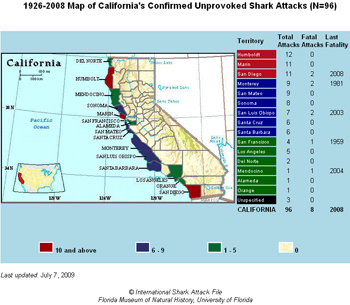
image link

Note: this report seems to have several flaws.

1. 79% of data comes from a form, the rest from news ect. The site itself notes this problem, “accounts of what happened were based primarily upon information supplied by persons who were neither the objects of the attacks nor were they even there at the time to actually see what happened”

2. Also this report seems to be cherry picking the data to some degree. Note that shark attacks this year for surfers was up, but if you look at the bigger picture divers made up the majority of attacks: divers 50 (46%) ; surfers, 41 (38%); swimmers, 12 (11%); and kayakers, 5 (5%).

3. The Committee is focused on the Pacific Coast of North America.

4. Lastly, this site is providing a valuable service to  the International Shark Attack File, so I thank them for their work.

To get a broader view of shark attacks world wide visit the ISAF.

There were 7 unprovoked shark attacks authenticated from the Pacific Coast of North America during 2009. All 7 of the reported attacks occurred in California and were distributed in the following months; April (1), July (1), August (2), October (1) and November (2), with 5 of the 7 attacks occurring South of the Santa Barbara/Ventura County line.

Activities of the victims were; 3 Surfing, 1 Paddle-Boarding, 1 Diving, 1Surf- Fishing, and 1 Swimming. The Great White Shark, Carcharodon carcharias, was positively identified or highly suspect as the causal species in 5 of the attacks with 1 attack attributable to the Thresher Shark, Alopias sp., and 1 unknown species.

The publication “Shark Attacks of the Twentieth Century” authenticated 108 unprovoked shark attacks from the Pacific Coast between 1900 and 1999. The Great White Shark was implicated in 94 (87%) of the attacks with an annual average of slightly more than one shark attack per year. The 7 cases reported for 2009 brings the total number of unprovoked shark attacks occurring along the West Coast during the first 9 years of the 21st Century to 49.

This is ‘more than five times’ the Twentieth Century annual average and represents 45% of the total number of attacks reported for the entire Twentieth Century, and all in less than a decade. The Great White Shark has been implicated in 41 (80%) of the 49 attacks reported during this Century. Of the 157 unprovoked shark attacks reported from the Pacific Coast since 1900, the Great White Shark has been positively identified or highly suspect in 133 (85%).

Victim activity for the 49 unprovoked shark attacks reported from the Pacific Coast since 20000 are distributed in the following groups; surfers 35 (71%) of the documented attacks with 5 (10%) swimmers, 3 (6%) kayakers, 3 (6%) divers, 2 (4%) paddle boarders, and 1 (2%) surf fishing. The number of adult, sub-adult, and juvenile Great White Sharks observed in Southern California during 2009 suggests a possible change in their population dynamics and seasonal site preferences.

The number of stranded marine mammal carcasses reported, specifically their location and time of year, would seem to support this observation. The Shark Research Committee will continue to closely monitor this activity in the coming year.

Additional information regarding the Shark Research Committee’s conservation, education, and research programs are available at:  sharkresearchcommittee.com. ‘Save the Sharks – Save the Oceans’
www.sharkresearchcommittee.com

story from surfersvillage

International Shark Attack File

Beaches With The
Most Shark Attacks
0

Beaches With The Most Shark Attacks.

According to George Burgess, an ichthyologist at the University of Florida who maintains a database called the International Shark Attack File. When the rare attack happens it’s usually a predatory mistake. “In the surf zone, where many attacks happen, sharks need to make quick decisions,” he said. “Humans on surfboards-hands splashing, feet kicking – can trigger a shark to think there’s trouble or a wounded animal, and it looks like an easy meal.”

check out the database here: www.flmnh.ufl.edu

But according to Laleh Mohajerani, executive director of the shark conservation organization Iemanya Oceanica, sharks are not looking to interfere with humans in the water. Our shark-attack fears are irrational, she said. “You are more likely to be hit by lightning.”

Indeed, there’s no arguing the numbers. Of the millions of people who enter the ocean each year, almost none are touched.

But for most people, fiery emotions override even the coldest numbers. A single scary story – be it on the news or in an effects-heavy Hollywood production – will destroy the efforts of hundreds of scientists trying to communicate on research and logic.

Take a dip if you dare.

New Smyrna Beach, Fla.
Due to its thousands of annual – as well as its toothy inhabitants that hunt offshore – New Smyrna is the shark attack capital of the world. That’s according to the International Shark Attack File, which cites 210 attacks in the beach’s home county of Volusia, Fla. But miles of white sand and consistent surf breaks continue to draw vacationers and locals alike into New Smyrna’s waters.

North Shore, Oahu, Hawaii
No. 2 on the International Shark Attack File for unprovoked attacks is Oahu, where tiger sharks, Galapagos sharks and sandbar sharks congregate in high numbers, especially near beaches on the island’s north shore. This doesn’t stop surfers, who flock to Velzyland Beach, the Leftovers Break and dozens of additional wave-beaten beaches where sharks search and swim.

Long Beach Island, N.J.
Source material for “Jaws,” a 1974 novel by Peter Benchley – and later a movie by Steven Spielberg – came from incidents at this New Jersey beach in 1916. In an unprecedented 11 days, five major shark attacks took place along the Jersey Shore, four of which were fatal. Reports cited blood turning the water red and sharks following victims toward the beach. Today, sharks are rare, but the legend lives on in the surf and swells of these tepid Atlantic waters.

Stinson Beach, Calif.
In the shadow of Marin County’s Mt. Tamalpais, Stinson Beach is a spot where great white sharks swim into the shallows. Patric Douglas, owner of Shark Diver, an ocean guiding outfit in San Francisco, said he has sighted them at Stinson – which is a neighboring stretch of sand east from Bolinas Beach (No. 3 on the list)- in less than 20 feet of water. “They’re coming to feed on seals, though it’s not uncommon for surfers to see them,” he said.

Beaches of Brevard County, Fla.
In the past 100 years, there have been 90 reported shark confrontations on beaches in this county on Florida’s east coast. Visitors head east from Orlando to the ocean to dip toes in the tepid waters at Cocoa Beach, Jetty Park and Klondike Beach, a 24-mile-long wilderness beach accessible only by foot in Canaveral National Seashore preserve.

Horry County, S.C.
South Carolina has seen more than 50 total shark attacks over the past century, according to the International Shark Attack File. Of those, 16 attacks are recorded off the beaches of Horry County, where the town of Myrtle Beach is famous as a tourist destination. The good news: The International Shark Attack File cites no fatal shark attacks in South Carolina since 1852.

Solana Beach, Calif.
A freak great-white attack in 2008 at Solana Beach in San Diego County, Calif., killed a 66-year-old swimmer. He was on a morning swim, training with a group when the attack occurred. Solana Beach, home to a population of seals, is at the periphery of the corridor where great sharks commonly roam.

story via